          |
   |
|||||||||||

| |||||||||||
 |
|||||||||||
|
Articles in this Issue:
McLean House Celebrates 70th Anniversary
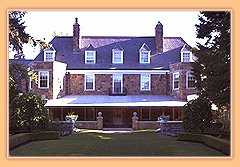
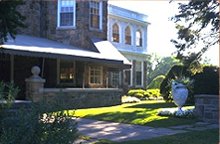
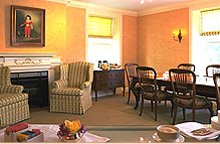
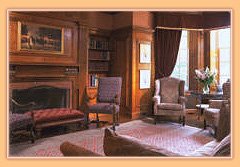
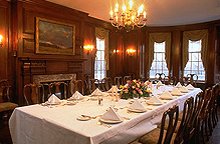
McLean House reached a landmark earlier this year. It has been seventy years since construction began on the Georgian style revival mansion, regarded as one of Ontario's finest examples of this type of architecture. McLean House was created by the innovative Canadian architect, Eric Arthur a professor of architecture at the University of Toronto. In 1929 Arthur was commissioned by J.S. McLean to design a unique home for his family. J.S. McLean was the President of Canada Packers Ltd., but is perhaps best known for his contribution to the arts in Canada. He was an avid collector of Canadian paintings, displayed proudly throughout his magnificent home. McLean's philanthropy continued beyond the confines of his home to the post-World War II McLean Foundation devoted to the assistance of educational, cultural and charitable works in Canada. McLean House has enjoyed a remarkably versatile existence. In 1967, the University of Toronto expropriated McLean House. The mansion became a clinic facility for the Donwood Institute for almost twenty years. In 1985, McLean House was converted into the splendid social and conference facility that it is today.
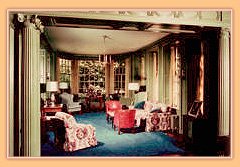
If J.S. McLean were to walk in the front door today, he would find few structural changes at McLean House. Aside from the subtle interior modifications required to convert a residence into a special events and conference facility, McLean House has undergone minimal changes. It has experienced little impact from development occurring on nearby lands. Even the Coach House, has weathered the past seventy years with dignity and remains an architectural gem in its own right. McLean House entered its seventh decade in style. Much of the mansion and the adjacent Coach House were refurbished earlier this year for the 70th anniversary. Managing Director Kirk Brady ensured the integrity of the beautiful mansion and Coach House was maintained. "It is critical to maintain the sense of history in one of Toronto's architectural landmarks," says Brady. "I believe my father would agree that the house is being put to good use," remarks Bill McLean. Celebrate seventy years of memories and philanthropy by hosting your next social or corporate event at McLean House.  Ten Reasons For Meeting Planners To Get Wired
Meetings... And Beyond Predicts The Estates The Estates of Sunnybrook have borne silent witness to most changes of the last three-quarters of the 20th century. They have gone from private residences, to clinics, to world class conference and social facilities. Since becoming conference facilities in the 1980s, the Estates have seen the way in which professionals meet, confer, and undergo interesting changes.
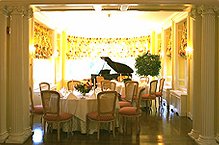
Meeting planners will seek out venues offering green space, relaxed atmospheres, and versatility to, compensate for urbanization and the isolation of technology. The Estates will continue to bring the corporate community via personalized service and superb facilities as the new millennium approaches. Spotlight on Estates' Managing Director Kirk Brady In honour of McLean House's 70th anniversary, Managing Director of the Estates, Kirk Brady shares his thoughts, and a few secrets, on successful marketing strategies for the hospitality industry. The Estates is one of Canada's premier venues hosting over 400 events each year from weddings, to parties, to corporate bookings. The man who oversees this successful enterprise is Kirk Brady, Managing Director of the Estates since 1993. Brady credits much of this success to The Estates' "integrated marketing strategy." Using a combination of the communications disciplines to deliver a common message, Brady believes this is the only way to stand out in Toronto's highly competitive market. "There is no question Toronto is full of venues catering to different tastes and budgets," says Brady. "We believe the Estates is unique and every component of our integrated marketing strategy sends that message. How many places in the city offer clients a chance to meet, play a game of baseball followed by a sit-down dinner in an elegant dining room?" Kirk Brady's integrated approach combines advertising, public relations, promotions and marketing all focused on the same message. Each component of the strategy has its own intrinsic value. When built into a synergistic communications plan, the consumer is left with a consistent impression of the Estates and its positioning. "Every facet of our marketing mix delivers a common message," says Brady. "Our advertising, promotions, printed literature, uniforms, even signage, are coordinated to present guests with the same message - the Estates of Sunnybrook offers elegance, exceptional service, and excellent cuisine in a beautiful surrounding." Kirk Brady acknowledges word of mouth plays an important role in promoting venues. He believes an integrated approach to marketing the Estates ads value and visibility. "Certainly many clients approach us through referrals, but our marketing approach helps achieve the maximum number of consumer impressions possible," explains Brady. "That's the key - you want your venue to stand out in people's minds, and want clients to be exposed to the Estate's image in a host of ways. The more ways people are reminded of your products and services, the more likely they will remember them. And the more they remember, the more they will think of your venue when it is time to plan their next social or corporate function." Mind Your Manners... It Matters If you think mealtime manners are as antiquated as opening the door for a lady or offering up your seat on the bus, think again. Many deals are brokered over a meal. Poor manners may not break a career; they do not go unnoticed. Here are a few tips on some of the important aspects of proper dining etiquette. If you are used to prepared meals or rarely eat anything that doesn't originate in a Styrofoam container, facing a formal table, complete with a perplexing number of utensils is an intimidating experience. There are rules that guarantee the right choice of silverware: Start from the outside in. The silverware is laid according to course. Begin with the outermost utensils, to the far left and far right of the plate, and work your way in with each course.
The napkin does more than just save face during a meal. It indicates when a meal or course commences and ends. It is important to know about proper napkin use. Make sure it is yours. The napkin can be set in numerous places - left of the plate, under the forks, in the centre of the plate, in a water or wine goblet, or to the right of the plate. Follow the host's lead. Place the napkin on your lap after the host has done so. Once everyone has done this, it is the signal for the meal to begin. White flag 3/4 the napkin is a key signal for serving staff. If you get up from the table during the meal and plan to return, place the napkin on your chair. At the end of the meal place the napkin on the table. Do not place it on the dishes. Throughout the meal, make your family proud by following a few rules showing your employer, colleagues, and clients that you were trained in etiquette: The host's behavior is the one to watch. Do not touch anything on the table until the host picks up his napkin or takes a sip of his drink. The host is also the first to begin eating. Always wait until everyone at the table is served before commencing the course. Avoid discussing food issues and diets during dinner. Everyone has become food conscious in the 90s. Discussing cholesterol while fellow diners tuck into a steak and baked potato is inappropriate. Any food allergies or other problems should be discussed with the serving staff away from the table so as not to disrupt the meal or cause a scene. Leaving your mark is important, but not on the glassware. Diners wearing lipstick should wipe their mouths before taking their first sip. Any re-applying of make-up, especially lipstick, should be done in the washroom, not at the table. Conquering Public Speaking: No Fear Call it "stage fright", "performance anxiety" or just plain old "nerves", few of us are immune to the jitters when faced with public speaking. When questioned, professionals cite giving a speech as number one fear. Here are three ways to conquer fears and deliver speeches like a pro.
Release all that pent up energy in the speech. Energy has to go somewhere. Use hand gestures for emphasis. Move around the stage between points to physically reinforce transition of ideas. Keeping nervous energy bottled up tends to make a speaker rigid. This lets the audience know, just how nervous you are. |
|||||||||||
|
To view the Agenda, click on the appropriate issue below:
Winter 2002 | Spring 2001 | Winter 2001 | Winter 2000 | Fall 1999 | Spring 1999| Winter 1999 | |||||||||||

Revenues generated from the Estates contribute to further research at
Sunnybrook & Women's College Health Sciences Centre.