NEWS AND VIEWS FOR THE CORPORATE COMMUNITY


Articles in this Issue:


Vaughan Estate: Imperial Grandeur

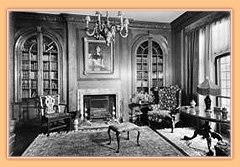
J.J. Vaughan's 1930s home office filled with comfortable antiques is now the Main Reception Area for events.

Toronto in the 1930s was a city in love with the British Empire - its style and accoutrements - and that sensibility is evident today in the elegant ambiance of the Vaughan Estate.

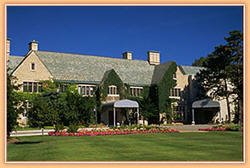
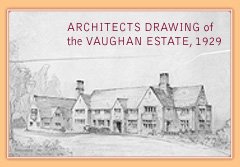
In 1927, John James Vaughan purchased land and built a fine home, "Donningvale" on the edge of the Sunnybrook Farms ravine, now called the Vaughan Estate. Built of grey stone, in the Jacobethan style it strikingly evoked an English country house, to which wealthy Toronto executives aspired in those days of the Empire. Its symmetrical parapeted gables, blue-grey slate roofs and Tudor entrances are but a few of the manor's details that give it such distinction.

Vaughan, was the right hand person for Sir John Eaton in operating the great department stores of the T. Eaton Company and its subsidiary ventures. He was a founding member of the Toronto Art Gallery (now AGO), and a director of Maple Leaf Gardens and the Bank of Toronto. Both Vaughan and his wife were active in charities and service clubs.

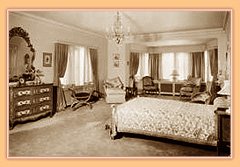
The restored property of today has been respectfully decorated in a style befitting the Imperial sense of hospitality that rekindles the haunting feeling of that era. It is a style the Estates are pleased to maintain for meeting holders in the new century.


Adding Value To Your Meetings


Four essential tips for meeting leaders
  • Prepare your audience. Nobody thinks best, even about a topic they're familiar with, when they work from a cold start. Give homework on your topic, asking your audience to be prepared to present their homework. Give examples of things to do to make them think about the topic. Your audience will arrive ready for your message.
  • Have participants work together on the subject. Whether they're small breakout groups, team problem solving, or manifesto or vision-writing exercises.
  • Do the unexpected. Dress up conventional and timeless ideas with new approaches. Give creative names to subjects you cover and address them.
  • Re-inforce. It's said that if you do not use a new word in your vocabulary repeatedly within two weeks of learning it, you'll forget it. The same holds true for your meetings messages. One new technique is run a temporary "listserv," a subscriber-only E-mail routing list, in which meeting attendees can be reminded of their recent learning experience and exchange ideas about the topics covered.
Consistent Presentations
Never look upon your presentations as chores to labour through. A great presentation is one that is central to your organization's communications strategy. Resist the urge to cobble together simple PowerPoint demonstrations by thinking strategically about the overall thrust of your communications. Be consistent in presentations: Enlist one person,
possibly someone from the marketing department or its equivalent, to oversee all content - its look, they way it sounds, the images and sounds.

Hone your overall approach by making sure all your presenters share notes on what works in delivering your message, and what doesn't. All organizations change constantly, so make sure your presenters have the most up-to-date information and make sure they apply it consistently.

Consider an in-house certification for presenters to bring their presentation skills up to snuff a kind of ISO 9000 for meetings. Retrain and re-certify your presenters to keep their skills sharp and to ensure they retain those skills. Provide incentives such as bonuses for certification.

This is an age of visual images. Make sure your visual messages are consistent and high quality. A shabby presentation will reflect on your organization. Entrust experts in PowerPoint, photographic slides and PC/Mac-based movies to make your visuals. If you can't afford an expert, try to keep your look consistent. Strong visuals can help your audience sort out complex ideas.

Be Prepared

Sometimes in a rush to prepare a visual presentation we can forget the simplest things. Keep these in mind:
  • Understand how your laptop ports to external monitors or projectors. Do you know which plug and which jack to use? Do you have the power cord? Do you have the proper software and have you used it enough times to know its limitations? Take your machine's manual if you're not sure.
  • With projectors, turn them on before your PC, so the computer can look for all connected peripherals and load the software drivers they need. If it's not turned on your PC will ignore it later. Match your projector to your audience size. Presenting to more than 40 means using a projector stronger than 850 lumens.
  • Keep your graphics simple and easy to distinguish from text in your slides. If you can't read the slides off your laptop from two metres away recreate them more simply. Use contrasting colours (red and yellow, blue and orange, purple and green) because they're easier to distinguish. And apart from being boring, white backgrounds make text more difficult to read off projection screens.

    Keeping Employees Happy

    The labour market is tightening. It is also refocusing around human talent. How to keep your staff loyal to your company? Here are three tips:

    • Challenge them: A good salary is not enough when you spend half your waking hours on the job. Give your employees challenging tasks that keep them interested and growing. Give employees the latitude to think creatively and give them the tools to do so. Don't bog your staff down in in-house bureaucracies and procedures.
    • Give them balance: Keep the workplace fresh and humane by allowing employees to take time to schmooze on the job, to take a modest amount of time to perform personal and family tasks. Take your people out to lunch so you can bond. These leavening moments are the foundation for creativity.
    • Counsel them: Your employees are human beings, subject to human feelings. Recognize them and offer to listen and advise when you seen someone who is blue, angry or upset.


    Teams Grow and Companies Flourish with Ropes Course

    Where do you go for adventure? You may be surprised. Few people realize that along with providing the finest meeting facilities in Toronto, the Estates is the location of one of the best adventure-based training centres in North America.

    Our partners at Summit Training and Development deliver one and two day team development programs designed to upgrade your companies most valuable resource - people. Take your organization to new heights on ropes course and experiential education activities. Summit's custom designed programs include a motivational speaker, team theory workshops, experiential initiatives, specific workplace transference breakouts, and in-house follow up. To book your next Summit program at the Estates call (905) 338-8451 or visit www.summittraining.org.


  • To view the Agenda, click on the appropriate issue below:

    Winter 2002 | Spring 2001 | Winter 2001 | Winter 2000 | Fall 1999 | Spring 1999| Winter 1999


    Copyright 2004 Estates of Sunnybrook. All rights reserved.

    Revenues generated from the Estates contribute to further research at
    Sunnybrook & Women's College Health Sciences Centre.